
About Hydra Island
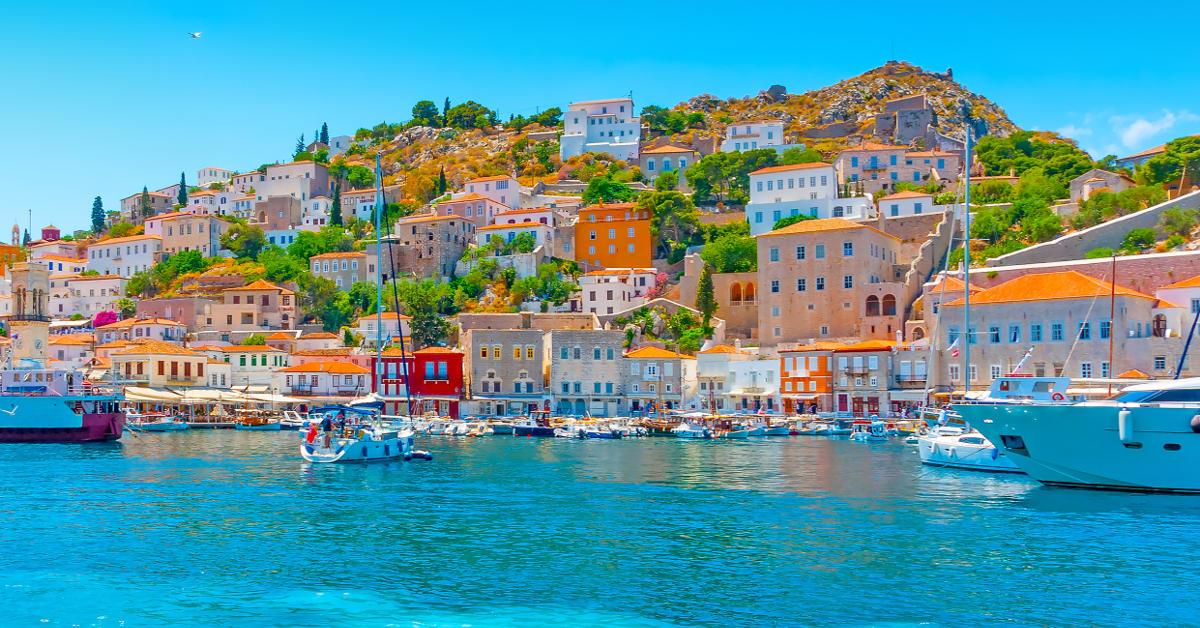
Hydra Island is one of the most distinctive islands of the Saronic Gulf, known for its historic stone mansions, picturesque harbor, maritime heritage, and almost complete absence of motor traffic.
One of Hydra’s most characteristic features is its traditional way of life. Private cars and motorcycles are not part of everyday transportation on the island, and visitors explore mainly on foot, while donkeys and mules continue to be used for carrying people and goods. Water taxis also connect the harbor with beaches and coastal areas around the island.
Located relatively close to Athens and the eastern coast of the Peloponnese, Hydra has long attracted Greek and international visitors. Its elegant architecture, preserved historic character, artistic tradition, and lively waterfront have made it one of the most cosmopolitan destinations in the Saronic Gulf.
Hydra at a Glance
The town of Hydra is built amphitheatrically around a natural harbor on the northern side of the island. Stone houses and impressive mansions rise gradually from the waterfront toward the surrounding rocky hills.
As a ship approaches the harbor, visitors can see the historic mansions overlooking the town, the old defensive bastions with their cannons, traditional fishing boats, sailing vessels, and yachts moored along the waterfront.
Narrow stone-paved streets lead away from the harbor through a maze of traditional houses, small squares, shops, galleries, cafés, and historic buildings.
The absence of ordinary road traffic is one of the reasons Hydra has preserved such a distinctive atmosphere. Walking remains the best way to discover the town and experience its architecture at a relaxed pace.
History of Hydra
Hydra has been inhabited since ancient times, although much less is known about its early history than about its later maritime development.
In antiquity the island was known as Hydrea, a name associated with water and the natural springs that once existed on the island. Despite a popular modern story, the island’s name is not connected with the mythological Lernaean Hydra killed by Heracles.
Hydra’s population increased significantly during the late medieval and early modern periods, when families from different parts of Greece and the surrounding mainland settled on the island.
From the 17th century onward, Hydra’s location and maritime experience helped transform the island into an important commercial and seafaring center.
The Maritime Power of Hydra
During the 18th and early 19th centuries, Hydra developed into one of the leading maritime powers of the Greek world.
Hydriot merchants and shipowners created an extensive trading network that reached ports throughout the Mediterranean and beyond. The island accumulated considerable wealth, and many of the impressive stone mansions that still surround the harbor were built during this period.
Hydra’s prosperity and powerful merchant fleet earned the island a prominent position among the great maritime communities of the Saronic Gulf.
Its commercial success was so remarkable that Hydra was sometimes referred to as “Little England”, a nickname reflecting the island’s strong shipping tradition, commercial wealth, and international connections.
Hydra and the Greek War of Independence
Hydra played a major role in the Greek War of Independence of 1821.
When the Revolution began, the island possessed one of the largest and most experienced merchant fleets in the Greek world. Wealthy shipowners and captains placed ships, crews, and financial resources at the service of the struggle for independence.
Merchant vessels were armed and converted for military use, becoming an essential part of the revolutionary Greek naval forces.
Among the most famous Hydriot naval commanders was Andreas Miaoulis, who became one of the leading admirals of the Revolution and played an important role in several major naval operations.
Hydra’s contribution to the struggle left a lasting mark on the island, and many of its historic houses, monuments, and museums preserve the memory of the families and sailors who participated in the Revolution.
Historic Mansions and Architecture
Hydra’s architecture is one of the island’s most recognizable features.
Large stone mansions built by wealthy shipowners stand above the harbor alongside traditional island houses with tiled roofs, narrow courtyards, and stone-paved streets.
One of the best-known historic buildings is the Lazaros Kountouriotis Historical Mansion, associated with one of the most important political and maritime families of the Greek War of Independence.
The Historical Archive-Museum of Hydra, located near the harbor, presents documents, paintings, historical objects, and material connected with the island’s naval tradition and its role in the creation of modern Greece.
Hydra’s long relationship with the sea is also reflected in the presence of the Merchant Marine Academy, continuing an educational tradition closely connected with Greek shipping.
Hydra and the Arts
Hydra became internationally known not only for its history but also for its strong connection with artists, writers, filmmakers, and musicians.
During the 20th century, the island attracted numerous Greek and international cultural figures who were inspired by its dramatic landscape, traditional architecture, and unique atmosphere.
In 1957, parts of the film Boy on a Dolphin, starring Sophia Loren, were filmed on Hydra. The film helped introduce the island to a wider international audience.
In the decades that followed, Hydra developed an increasingly international artistic reputation. Painters, writers, photographers, and musicians spent time on the island, while historic buildings and former industrial spaces have also been used for exhibitions and contemporary art projects.
This combination of maritime tradition and modern creativity remains an important part of Hydra’s identity today.
Monasteries and Walking Routes
Beyond the harbor, Hydra offers a network of walking paths leading through the rocky landscape to monasteries, viewpoints, beaches, and quieter parts of the island.
Several historic monasteries are located in the hills above Hydra Town. Reaching some of them requires a substantial walk, but the routes offer impressive views across the island and the surrounding sea.
Among the most important religious sites are the Monastery of Prophet Elias and the nearby Monastery of Agia Efpraxia, situated high above Hydra Town.
The island’s car-free environment makes walking an essential part of the Hydra experience, whether visitors remain around the harbor or follow longer routes into the interior.
Beaches and Coastal Life
Hydra’s coastline offers a variety of swimming spots, rocky coves, and small beaches surrounded by clear waters.
Popular areas include Spilia, Hydronetta, Kamini, Vlychos, and Mandraki, while more distant beaches can be reached by water taxi or excursion boat from the harbor.
The combination of swimming, walking, sailing, and waterfront dining allows visitors to experience a very different side of the island beyond its historic center.
Hydra Today
Today, Hydra successfully combines its historic character with a lively contemporary atmosphere.
The harbor remains the center of island life, surrounded by traditional houses, museums, cafés, restaurants, galleries, and shops. At the same time, the absence of ordinary motor traffic helps preserve a sense of continuity with the island’s past.
Visitors can explore historic mansions, learn about Hydra’s contribution to the Greek War of Independence, follow walking paths through the hills, swim in the clear waters of the Saronic Gulf, or simply enjoy the view of the harbor from one of its waterfront cafés.
With its remarkable maritime history, preserved architecture, artistic tradition, and distinctive car-free atmosphere, Hydra Island remains one of the most memorable destinations near Athens.


Discover Hydra Island on one of our cruises
Hydra is also one of the three islands visited on our One Day Cruise from Athens to Hydra, Poros & Aegina, offering visitors the opportunity to experience its historic harbor, traditional architecture, and distinctive car-free atmosphere as part of a full-day cruise through the Saronic Gulf.
Tours We Recommend


1 Day Cruise from Athens to 3 Islands – Poros, Hydra, Aegina
From: