
About Poros Island

Poros Island is a small and picturesque island in the Saronic Gulf, located very close to the northeastern coast of the Peloponnese. Known for its pine-covered hills, sheltered bays, traditional architecture, and lively waterfront, Poros is a popular destination for both Greek and international visitors.
Poros is actually formed by two islands: Sferia, the smaller island of volcanic origin where Poros Town is built, and the much larger and greener Kalaureia. The two are connected by a narrow bridge.
Across the narrow sea passage lies the town of Galatas on the Peloponnese. At its narrowest point, only a few hundred meters of water separate Poros from the mainland.
The name Poros comes from the Greek word meaning a passage or crossing, an appropriate name for an island positioned beside such a narrow sea channel.
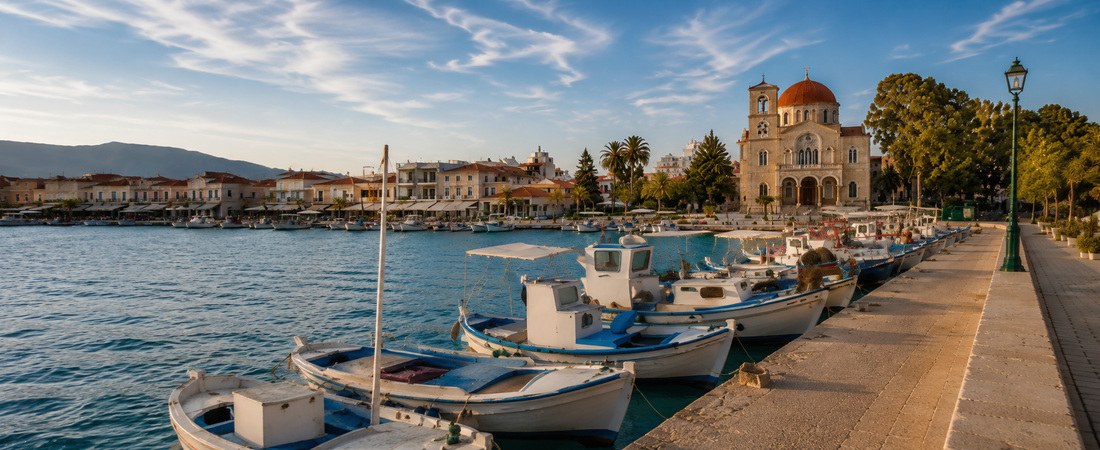
As visitors approach Poros by sea, one of the first sights is the amphitheatrically built town rising above the harbor, with its white and pastel-colored houses, tiled roofs, waterfront cafés, and the famous Clock Tower standing above the town.
Poros at a Glance
Poros is one of the greenest islands of the Saronic Gulf. Large areas of Kalaureia are covered with pine forests that extend toward the coast and create a landscape very different from many of the drier islands of Greece.
The island’s protected bays have also made Poros popular with sailing boats and yachts. Around Megalo Neorio and Mikro Neorio, visitors will find beaches, small harbors, and areas surrounded by pine trees.
Poros Town is concentrated mainly on Sferia. Its narrow streets climb from the waterfront toward the hilltop, offering views over the harbor, Galatas, and the mountains of the Peloponnese.
Because Poros is relatively close to Athens, it has long been a popular destination for short holidays, weekend trips, sailing excursions, and summer vacations.
History and Mythology
The history of Poros reaches back to prehistoric times. Archaeological discoveries on Kalaureia show that the area was inhabited and used from the Bronze Age onward, with evidence of activity continuing through the Mycenaean, Archaic, Classical, Hellenistic, and Roman periods.
In antiquity, Kalaureia became particularly important because of the Sanctuary of Poseidon, one of the most significant ancient sites on the island.
According to ancient Greek tradition, Poseidon and Apollo exchanged sacred places. Kalaureia became associated with Poseidon, while Delphi became one of the great sanctuaries of Apollo.
The sanctuary developed into an important religious center and was connected with a wider network of communities around the Saronic Gulf.
The Sanctuary of Poseidon
The ruins of the Sanctuary of Poseidon are located in the northern part of Kalaureia, surrounded by the peaceful landscape of Poros.
The sanctuary was an important place of worship in ancient Greece and included a temple dedicated to Poseidon together with other buildings connected with religious and civic activity.
The visible remains mainly belong to structures developed during the Archaic, Classical, and later periods, although archaeological research has shown that activity at the site began much earlier.
Systematic archaeological research has greatly expanded our understanding of the sanctuary. Swedish archaeologists carried out important excavations at the site in the late 19th century, while modern archaeological investigations have continued to reveal new information about Kalaureia and its ancient inhabitants.
Demosthenes and Poros
One of the most famous historical figures associated with ancient Poros is the Athenian statesman and orator Demosthenes.
In 322 BC, after the defeat of the Greek resistance to Macedonian rule, Demosthenes fled to Kalaureia and sought refuge in the Sanctuary of Poseidon.
When soldiers arrived to arrest him, Demosthenes took poison and died within the sanctuary rather than allow himself to be captured.
His death gave the Sanctuary of Poseidon an additional place in the political and cultural history of ancient Greece.
Poros and the Greek War of Independence
Poros also played an important role during the Greek War of Independence and the creation of the modern Greek state.
The island supported the Greek struggle for independence and later became an important meeting place during the diplomatic negotiations that helped determine the future of the new state.
In 1828, representatives of Great Britain, France, and Russia met on Poros and held discussions with Ioannis Kapodistrias, the first Governor of Greece.
The discussions resulted in recommendations concerning the territorial boundaries and political organization of the emerging Greek state. These negotiations formed part of the diplomatic process that eventually led to the international recognition and definition of independent Greece.
Poros and the Hellenic Navy
Poros has a particularly strong connection with the maritime history of modern Greece.
In 1827, one of the first important naval installations of the newly forming Greek state was established on the island. Poros subsequently developed into an important naval base, shipbuilding center, and training location.
The island’s sheltered natural harbor made it particularly suitable for naval activities, and its connection with the Hellenic Navy continued for many decades.
The historic battleship Georgios Averof was also anchored at Poros from 1957 until 1983. It was later transferred to Palaio Faliro in Athens, where it is preserved today as a floating naval museum.
The Russian Naval Base
Another interesting reminder of Poros’ naval history can be found at the remains of the Russian Naval Base on the western side of the island.
During the 19th century, Russian naval activity in the region led to the development of facilities on Poros for supplying and supporting Russian ships operating in the Mediterranean.
The surviving ruins stand beside the sea and form one of the island’s most distinctive historical landmarks.
The Monastery of Zoodochos Pigi
The Monastery of Zoodochos Pigi is one of the most important religious monuments of Poros.
Surrounded by pine trees in the eastern part of the island, the monastery combines religious significance with a peaceful natural setting.
Its location away from the busy harbor offers visitors a very different view of Poros and reflects another important part of the island’s long cultural history.
Poros Town and the Clock Tower
Poros Town is one of the island’s main attractions in its own right. Traditional houses, neoclassical buildings, narrow streets, small squares, shops, and waterfront cafés create a distinctive island atmosphere.
The most recognizable landmark is the Clock Tower, situated on the highest point of Sferia above the town.
From the area around the Clock Tower, visitors can enjoy panoramic views across Poros, the narrow channel, Galatas, and the surrounding coastline of the Peloponnese.
The Archaeological Museum of Poros also provides an opportunity to discover finds from Poros and the wider region, including material connected with the Sanctuary of Poseidon and ancient settlements of the northeastern Peloponnese.
Beaches and Natural Landscape
Although Poros is strongly associated with history and naval tradition, much of its appeal comes from its natural landscape.
Pine forests reach close to the sea in several parts of the island, creating attractive swimming areas and shaded coastal scenery.
Popular areas include Askeli, Kanali, Mikro Neorio, Megalo Neorio, and Love Bay, together with smaller coves around the island.
The combination of calm waters, green hills, walking routes, beaches, and protected bays also makes Poros popular for sailing and other outdoor activities.
Poros Today
Today, Poros combines the atmosphere of a traditional Greek island with ancient history, naval heritage, pine-covered landscapes, beaches, and easy access from both Athens and the Peloponnese.
Visitors can explore the Sanctuary of Poseidon, walk through the streets of Poros Town, climb toward the Clock Tower, visit the Monastery of Zoodochos Pigi, discover the island’s naval history, or simply enjoy the waterfront and surrounding beaches.
Its combination of history, natural beauty, and proximity to mainland Greece makes Poros Island one of the most distinctive destinations in the Saronic Gulf.


Discover Poros Island on one of our cruises
Poros is one of the three destinations included in our One Day Cruise from Athens to Hydra, Poros & Aegina, giving visitors time to explore its picturesque waterfront, traditional town, and views of the Saronic Gulf during a full-day island cruise from Athens.
Tours We Recommend


1 Day Cruise from Athens to 3 Islands – Poros, Hydra, Aegina
From: