
About Cape Sounion

Cape Sounion is one of the most dramatic coastal landmarks in Attica, located at the southernmost tip of the peninsula, approximately 69 km southeast of Athens.
Standing high above the Aegean Sea are the marble columns of the ancient Temple of Poseidon, one of the most important sanctuaries dedicated to the god of the sea in ancient Greece.
For the ancient Athenians, Sounion was far more than a religious site. Its position overlooking important sea routes made it a strategic fortress, maritime landmark, and gateway to Athens and the mineral-rich region of Laurion.
Cape Sounion at a Glance
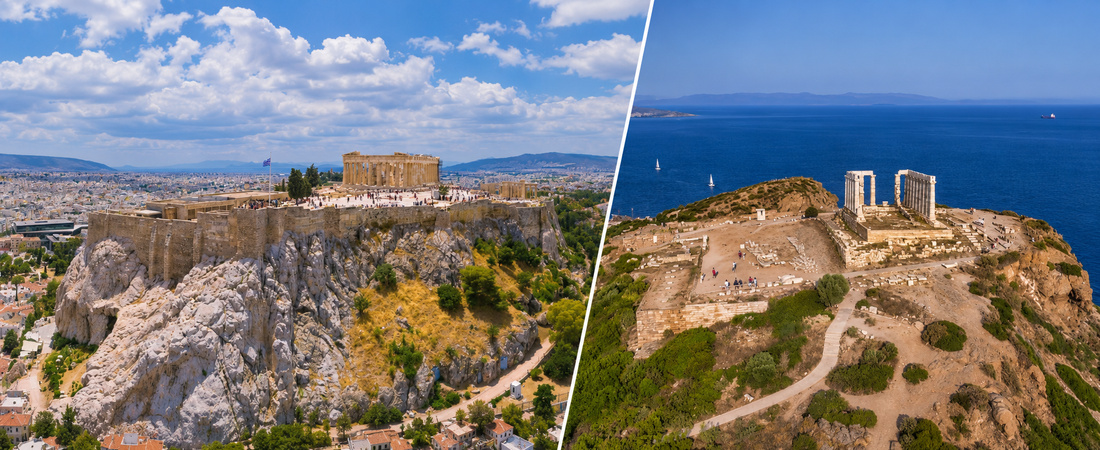
The archaeological site occupies a rocky headland surrounded by the sea on three sides.
Its elevated position provides panoramic views across the Aegean and made Sounion an ideal location for both a sanctuary and a fortified observation point.
The area was associated with religious activity for many centuries, while archaeological evidence shows human presence in the wider region from prehistoric times.
The surviving classical Temple of Poseidon was constructed during the 5th century BC and remains the most recognizable monument at the site.
Sounion in Homer’s Odyssey
Sounion appears in one of the earliest surviving works of Greek literature, Homer's Odyssey.
During the story of the Greek warriors returning from Troy, Phrontis, the skilled helmsman of King Menelaus of Sparta, dies as the fleet reaches Sounion.
Menelaus stops at the cape to perform funeral rites for his companion before continuing his difficult journey home.
This ancient literary reference demonstrates that Sounion was already considered an important and recognizable landmark for sailors travelling through the Aegean.
The Legend of Aegeus and Theseus
According to a popular tradition, Cape Sounion is associated with the tragic death of King Aegeus of Athens.
His son Theseus had sailed to Crete as one of the young Athenians sent to King Minos, where he planned to enter the Labyrinth and kill the Minotaur.
Before leaving, Theseus promised his father that if he returned safely he would replace the ship's black sail with a white one.
Theseus successfully killed the Minotaur and escaped from Crete, but according to the myth he forgot to change the sail.
Seeing the black sail as the ship returned, Aegeus believed that his son had died and threw himself into the sea.
The Aegean Sea was traditionally said to have taken its name from Aegeus.
Ancient literary sources do not all place Aegeus' death at Sounion, so the association of the story specifically with Cape Sounion is best understood as a later popular tradition.
The Ancient Sanctuary of Poseidon
The sanctuary at Sounion developed into an important religious center dedicated to Poseidon, the ancient Greek god of the sea.
For sailors approaching Attica, the sanctuary occupied a highly symbolic position overlooking the maritime routes leading toward Athens.
Religious activity at Sounion is documented from the early Archaic period, and the sanctuary became increasingly monumental during the 6th and 5th centuries BC.
A major festival was held at Sounion every four years, with officials and participants travelling to the sanctuary, including by sacred ship.
The Temple of Poseidon
The surviving Temple of Poseidon was built approximately between 444 and 440 BC, during the great building activity of Classical Athens.
It is a Doric peripteral temple, originally surrounded by six columns across the short sides and thirteen along the long sides.
The temple measured approximately 31.1 by 13.5 meters and was constructed from local marble quarried at nearby Agrileza.
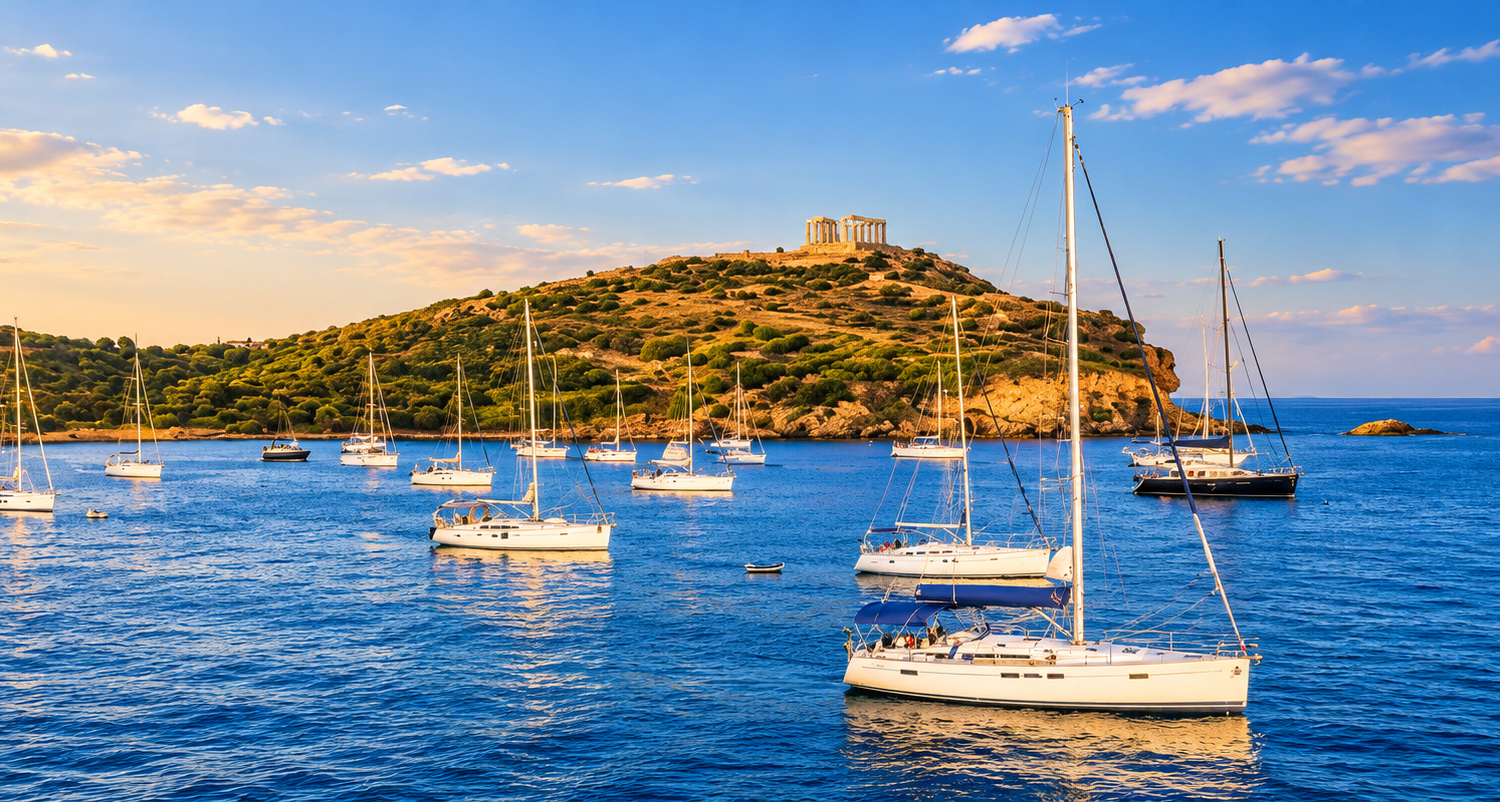
Its position high above the sea made the monument visible to ships travelling along the coast of Attica.
The sculptural decoration included scenes associated with mythology, including the Labors of Theseus and the battle between Lapiths and Centaurs.
The Persian Destruction and Classical Rebuilding
Before the surviving marble temple was built, an earlier monumental Temple of Poseidon stood on the same site.
This earlier temple was constructed from poros limestone and had begun to take shape around the beginning of the 5th century BC.
It was destroyed during the Persian invasion of Attica in 480 BC, when Persian forces also destroyed the major sanctuaries of Athens.
Several decades later, the Athenians rebuilt the sanctuary on a grander scale, creating the marble temple whose columns dominate Cape Sounion today.
The Sanctuary of Athena Sounias
Poseidon was not the only deity worshipped at Sounion.
Approximately 400 meters northeast of the Temple of Poseidon stood an important sanctuary dedicated to Athena Sounias.
The sanctuary contained a distinctive temple and other structures connected with the worship of Athena.
During the Roman period, parts of the temple were dismantled, and architectural elements were later reused elsewhere in Athens.
The remains of the Sanctuary of Athena show that ancient Sounion was a larger religious complex rather than a site devoted exclusively to Poseidon.
Sounion, Laurion and the Silver Mines
The importance of Sounion was closely connected with the mineral-rich region of Laurion and Lavreotiki.
The silver mines north of the cape were among the most valuable economic resources of ancient Athens.
Revenue from the mines contributed significantly to Athenian wealth and, during the early 5th century BC, helped support the development of the powerful fleet that played a decisive role in the Persian Wars.
Ancient mining installations and quarrying areas can still be found throughout the wider Lavreotiki region.
The local marble used for the Temple of Poseidon was quarried nearby at Agrileza, further demonstrating the close connection between the sanctuary and the surrounding landscape.
The Fortress and Ancient Harbor
Sounion also had considerable military importance.
The sanctuary and settlement were protected by a fortified wall with towers, while the natural harbor below served ships travelling along the Attic coastline.
The site included facilities connected with naval activity, including ancient ship sheds used for warships.
Its strategic location allowed the Athenians to monitor maritime traffic entering and leaving the Saronic and Aegean sea routes around southern Attica.
Sounion During the Peloponnesian War
During the Peloponnesian War, Sounion became especially important for the defense of Athens.
In 413–412 BC, the Athenians strengthened the fortifications of the cape in order to protect the sea route used by grain ships and other vessels supplying the city.
This route had become increasingly important after Spartan forces occupied Decelea in northern Attica and disrupted overland communications.
The fortified position at Sounion therefore helped protect both maritime trade and the food supply of Athens.
In a later period, groups of runaway slaves from the nearby Laurion mines also used the fortified area during episodes of unrest.
Lord Byron at Cape Sounion
One of the most famous later visitors to Cape Sounion was the English Romantic poet Lord Byron.
Byron travelled extensively in Greece and visited Sounion during the early 19th century.
His name can still be seen carved into one of the marble elements of the Temple of Poseidon, although such inscriptions would of course be prohibited today.
Byron's fascination with Greece, its ancient monuments, and its struggle for independence later made him one of the most famous European supporters of the Greek cause.
Sunset at Cape Sounion
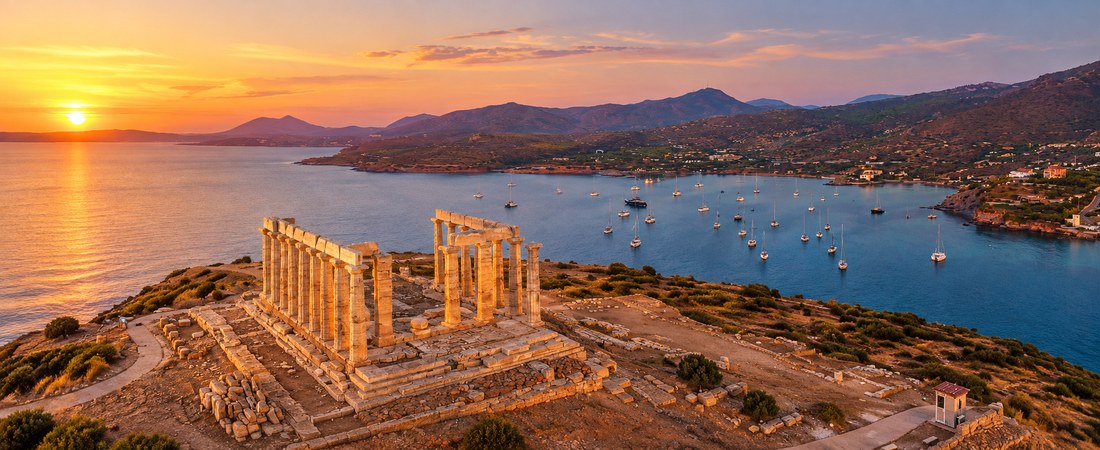
Today, Cape Sounion is especially famous for its spectacular sunset.
As the sun descends over the sea, the marble columns of the Temple of Poseidon are illuminated by the changing evening light.
The elevated archaeological site offers wide views across the Aegean Sea and the surrounding coastline of Attica.
The combination of ancient architecture, mythology, sea, and landscape makes sunset at Sounion one of the most memorable experiences within easy reach of Athens.
Visit Cape Sounion from Athens
Cape Sounion can be reached from Athens by following the coastal road along the Athens Riviera.
The journey passes seaside districts, beaches, and coastal landscapes before reaching the southern tip of Attica and the Temple of Poseidon.
Visitors can explore the archaeological site, learn about its mythology and maritime history, and enjoy panoramic views of the Aegean Sea.