
About Nauplion City in Argolis Region
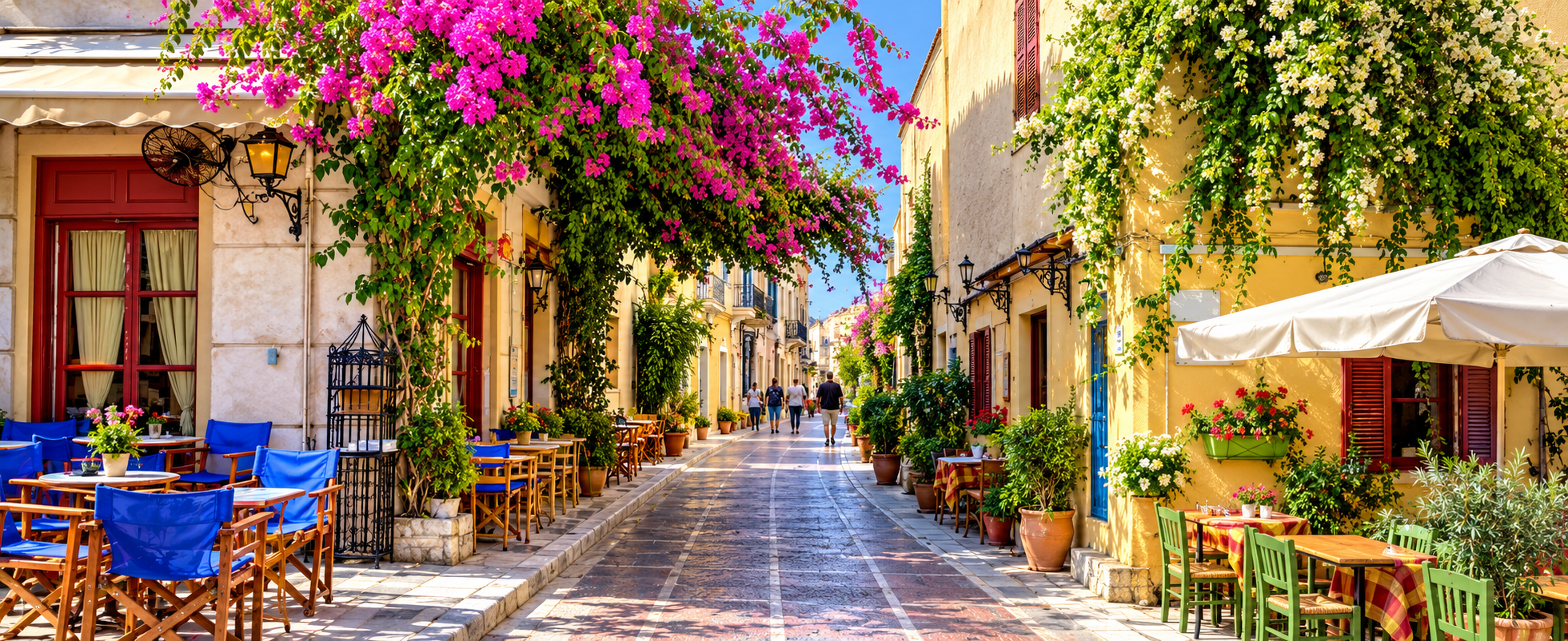
Nafplio is one of the most beautiful historic cities in Greece and one of the most popular destinations in the Peloponnese. Located on the Argolic Gulf, it combines elegant neoclassical architecture, Venetian and Ottoman monuments, impressive fortresses and a picturesque waterfront.
Nafplio also holds a special place in modern Greek history. From 1827 to 1834, it served as the first capital of the newly established Greek state and became the political center of the country during the years of Ioannis Kapodistrias and the arrival of King Otto.
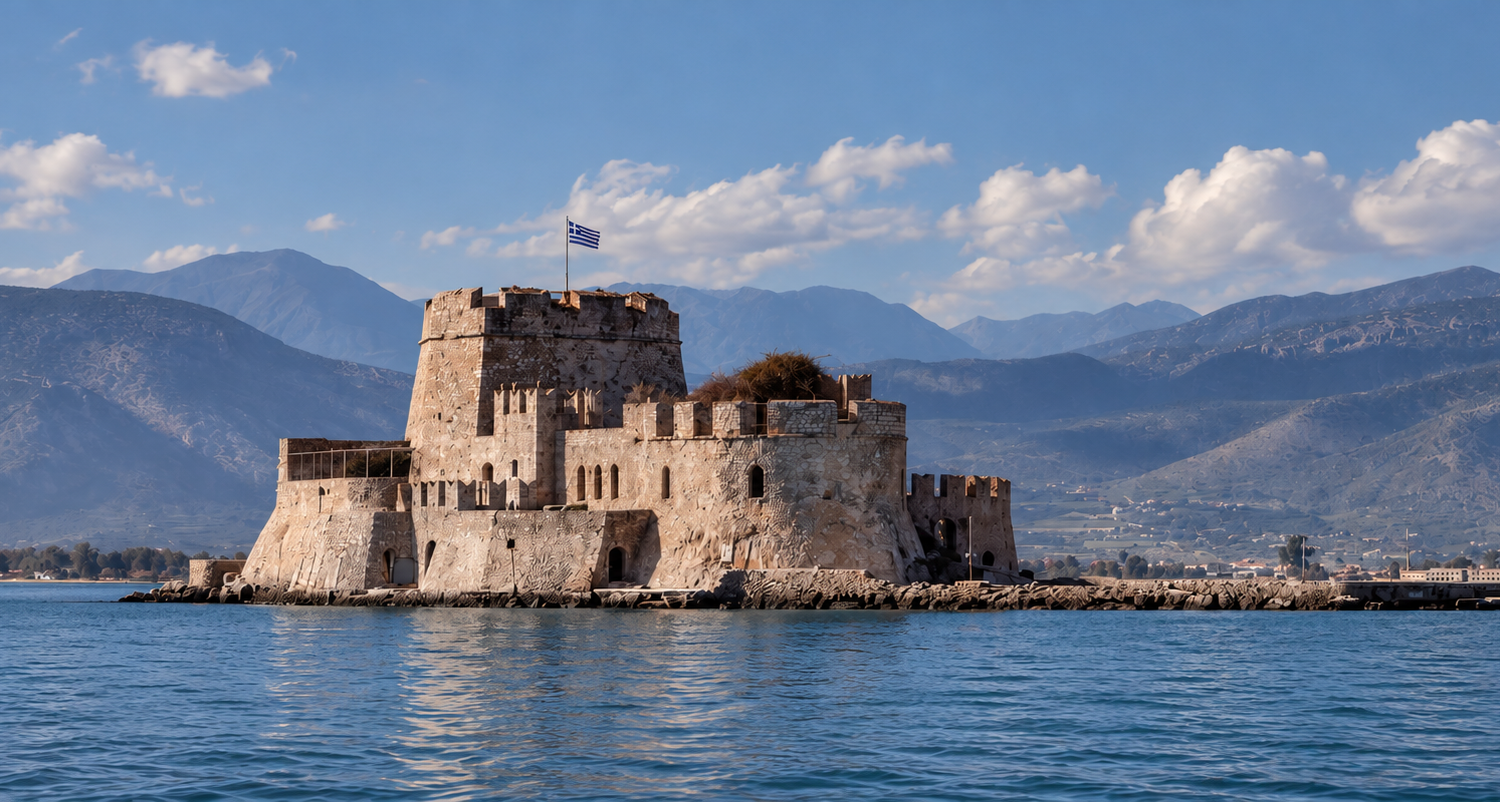
Today, visitors can explore the narrow streets of the Old Town, climb to the imposing Palamidi Fortress, discover the historic Acronafplia, visit Syntagma Square and admire the iconic Bourtzi fortress standing in the harbor.
Nafplio at a Glance
- Location: Argolis, northeastern Peloponnese
- Setting: on the Argolic Gulf
- First capital of the modern Greek state: 1827–1834
- Major landmarks: Palamidi Fortress, Acronafplia, Bourtzi and Syntagma Square
- Historic influences: Byzantine, Frankish, Venetian, Ottoman and modern Greek
- Important historical figure: Ioannis Kapodistrias, first Governor of Greece
- Known for: historic architecture, seaside promenades, fortifications and the Old Town
From Mythology to Ancient Nafplio
According to Greek mythology, Nafplio was named after Nauplius, traditionally described as a son of Poseidon and Amymone.
Mythological stories connected the wider region with many of the great legendary traditions of ancient Greece. These stories belong to mythology and literary tradition rather than to the archaeological record.
Archaeological evidence shows that human activity in the area reaches back to prehistoric times. Traces of early occupation have been identified in several locations around modern Nafplio, including Acronafplia and Palamidi.
At Acronafplia, remains of an organized settlement and an early phase of fortification date to around the end of the 4th century BC.
A City Shaped by Many Civilizations
The appearance of Nafplio today reflects centuries of political and cultural change.
During the Byzantine period, settlement was concentrated mainly around Acronafplia, the rocky fortified hill above the Old Town.
From the medieval period onward, Nafplio came successively under Frankish, Venetian and Ottoman control. Each period left its own architectural and defensive features.
The Venetians had a particularly important influence on the city's fortifications and urban development. They strengthened Acronafplia, expanded the lower city, constructed Bourtzi in the harbor and later created the great fortress of Palamidi.
Nafplio – The First Capital of Modern Greece
Nafplio entered one of the most important periods of its history during the Greek War of Independence.
The city was liberated from Ottoman control in 1822 after Greek forces captured Palamidi Fortress.
In 1827, Nafplio was chosen as the capital of the newly formed Greek state. The city remained the capital until 1834, when the capital was transferred to Athens.
During these years, Nafplio became the center of the new government's political and administrative life and witnessed some of the most important events in the formation of the modern Greek state.
Ioannis Kapodistrias and Nafplio
Ioannis Kapodistrias, the first Governor of Greece, arrived in Nafplio in 1828.
During his administration, important institutions and public works were established as the new Greek state attempted to create an organized system of government.
Kapodistrias' life came to a tragic end in Nafplio in 1831, when he was assassinated outside the Church of Agios Spyridon.
The event remains one of the most important episodes in the modern history of the city and of Greece.
The Old Town of Nafplio
The Old Town of Nafplio is the historic heart of the modern city.
Narrow streets, small squares, neoclassical houses, balconies, Ottoman fountains and Venetian buildings create a distinctive architectural character.
The historical center developed largely on land created and expanded during the Venetian period, beneath the older fortified hill of Acronafplia.
Today, the Old Town is ideal for walking, shopping and discovering historic buildings hidden along its streets and squares.
Syntagma Square
Syntagma Square is the central historic square of Nafplio and is surrounded by some of the city's most important monuments.
Among the buildings around the square are the Archaeological Museum of Nafplio, housed in a former Venetian naval warehouse, and the Vouleftiko, a former Ottoman mosque that later housed the Greek Parliament.
The square has played an important role in the social and political life of Nafplio for centuries and remains one of the liveliest gathering places in the Old Town.
The Vouleftiko – The Old Parliament Building
The building known today as the Vouleftiko was originally constructed as an Ottoman mosque around 1730.
After the liberation of Nafplio, the building was adapted for new uses and housed the parliament of revolutionary Greece from the autumn of 1825 until the spring of 1826.
Its later history was equally varied. It was used for education, public events and judicial proceedings, including the famous 1834 trial of Theodoros Kolokotronis and Dimitrios Plapoutas.
The Archaeological Museum of Nafplio
The Archaeological Museum of Nafplio stands prominently on Syntagma Square inside an impressive Venetian stone building constructed in 1713 as a naval warehouse.
The museum presents the archaeology of Argolis from prehistoric times through the Roman period.
Its collections include finds from some of the most important archaeological sites in the region, including Mycenaean centers such as Tiryns and other settlements of Argolis.
One of its most remarkable exhibits is the famous bronze armor from Dendra, dating to the 15th century BC and associated with an elite Mycenaean warrior.
Palamidi Fortress
Rising high above Nafplio is the magnificent Palamidi Fortress, one of the most impressive Venetian fortifications in Greece.
The fortress was constructed by the Venetians in the early 18th century and consists of a sophisticated system of independent but interconnected bastions.
Palamidi stands on a hill approximately 216 meters above sea level and offers panoramic views across Nafplio and the Argolic Gulf.
A famous local tradition speaks of 999 steps leading from the town toward the fortress. In reality, the staircase has approximately 857 steps.
After the Greek liberation of Nafplio, sections of Palamidi were used as prisons. The Miltiades Bastion is particularly associated with the imprisonment of the Greek revolutionary leader Theodoros Kolokotronis.
Acronafplia – The Ancient Fortress Above the Old Town
Acronafplia is the rocky fortified peninsula that rises immediately above the Old Town and represents one of the oldest continuously used areas of Nafplio.
Fortifications were constructed and modified here during different historical periods, including ancient, Byzantine, Frankish, Venetian and Ottoman times.
The surviving walls therefore preserve evidence of many different phases in the city's history.
Before the expansion of the lower town toward the sea, Acronafplia formed the principal fortified settlement of Nafplio.
Bourtzi – The Fortress in the Sea
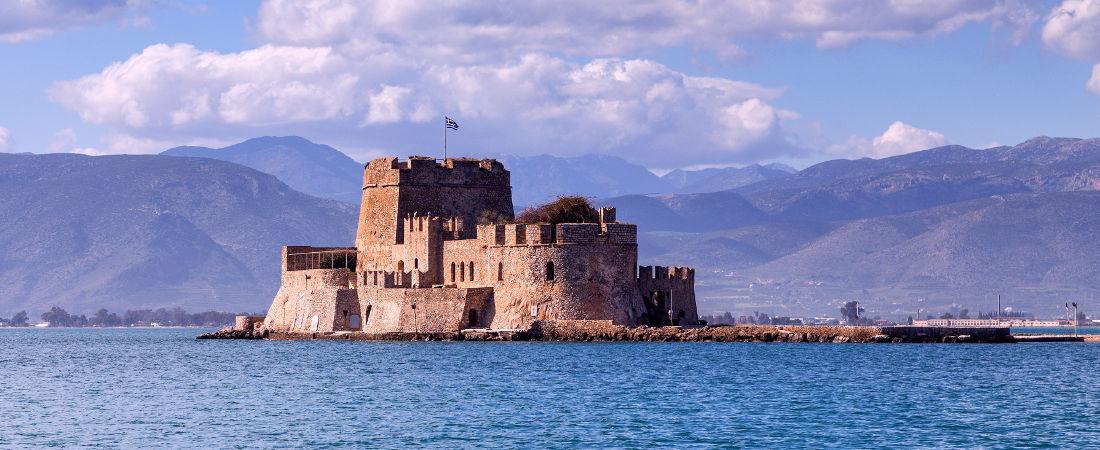
One of the most recognizable landmarks of Nafplio is Bourtzi, the small fortress situated on an islet in the middle of the harbor.
The Venetians began constructing the fortress in 1473 to strengthen the defenses of the port.
Bourtzi was designed to control access to Nafplio from the sea and was connected to the city's wider defensive system.
Over the centuries, the fortress served many different purposes. It functioned as a military stronghold, a place of refuge and, much later, even as accommodation.
Today, Bourtzi remains one of the defining images of Nafplio and can be reached by boat from the waterfront.
The Church of Agios Spyridon
The Church of Agios Spyridon is one of the most historically significant churches in Nafplio.
Completed in 1702 during the second Venetian occupation, the church became closely connected with one of the most tragic moments in modern Greek history.
On 27 September 1831, Ioannis Kapodistrias was assassinated at the entrance to the church by Konstantinos and Georgios Mavromichalis.
The site remains an important historical landmark for visitors interested in the early years of the modern Greek state.
The Seafront and Arvanitia
Nafplio's waterfront is one of the most attractive parts of the city and offers open views toward Bourtzi and the Argolic Gulf.
The harbor is lined with cafes and restaurants and provides an ideal setting for an evening walk.
Visitors can also explore the coastal route around Arvanitia, beneath the fortifications of Acronafplia, where the landscape combines sea views with the historic walls of the city.
Nafplio Today
Today, Nafplio combines its extraordinary historical heritage with the relaxed atmosphere of a seaside city.
Visitors can explore castles and museums in the morning, walk through the Old Town, enjoy traditional Greek food in the squares and spend the evening along the waterfront overlooking Bourtzi.
The city's compact historical center makes it particularly enjoyable to explore on foot, while its location in Argolis makes it an excellent base for visiting nearby archaeological sites such as Mycenae and Epidaurus.
Visit Nafplio from Athens
Nafplio is one of the most rewarding destinations to visit from Athens and is frequently combined with the archaeological sites of Mycenae and Epidaurus.
An organized tour allows visitors to experience the major archaeological sites of Argolis together with free time to explore the historic streets and waterfront of Nafplio.
Discover Nafplio together with Mycenae and Epidaurus


Admire the Nauplion with one of our tours:
- One Day Tour To Mycenae and Nafplio (Argolis)
- 2 Day Tour To Mycenae, Nafplio and Epidaurus
- 3 Day Tour To Epidaurus, Mycenae, Nafplio, Olympia and Delphi Archaeological Sites
- 4 Day Tour To Epidaurus, Mycenae, Nafplio, Olympia, Delphi and Meteora Monasteries
- 5 Day Tour To Epidaurus, Nafplio, Mycenae, Olympia, Delphi and Meteora Monasteries
- 7 Day Tour In Greece Through the Centuries
Tours We Recommend
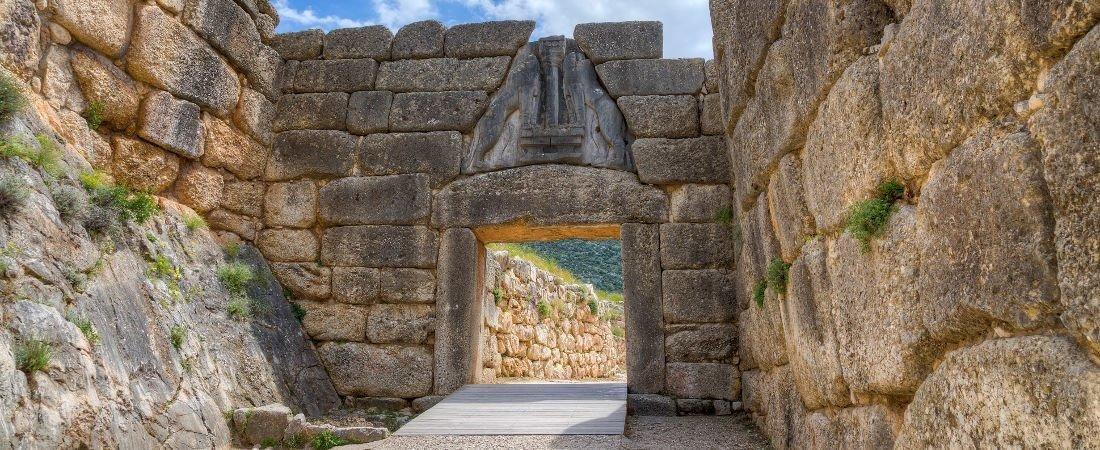
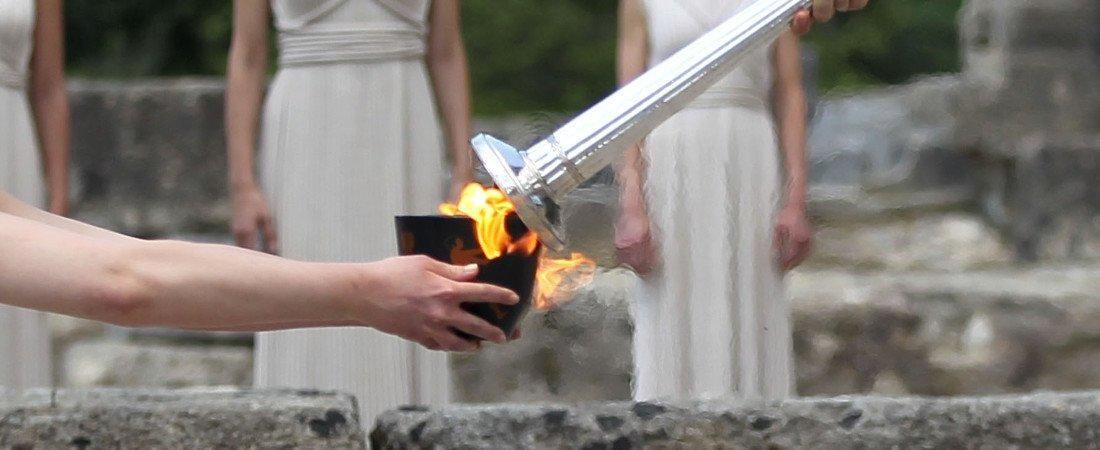

3 Day Tour To Epidaurus, Mycenae, Nauplio, Olympia and Delphi Archaeological Sites
From: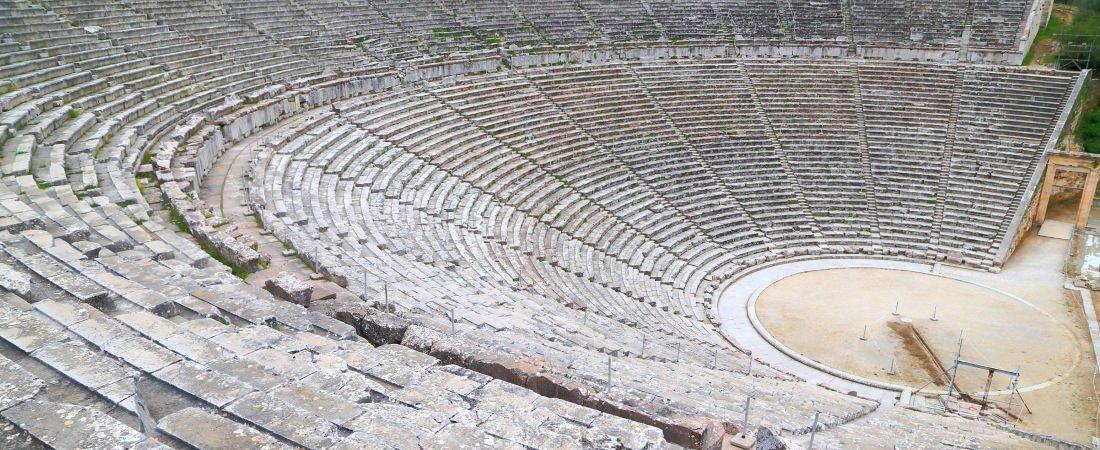
4 Day Classical Tour To Epidaurus, Mycenae, Nauplion, Olympia, Delphi and Meteora Monasteries
From:
5 Day Tour To Epidaurus, Nauplion, Mycenae, Olympia, Delphi and Meteora Monasteries
From: